


Review
The Architectural Imagination at the Digital Turn
REVIEW BY: PARI RIAHI




REVIEW BY: PARI RIAHI
August 15, 2025
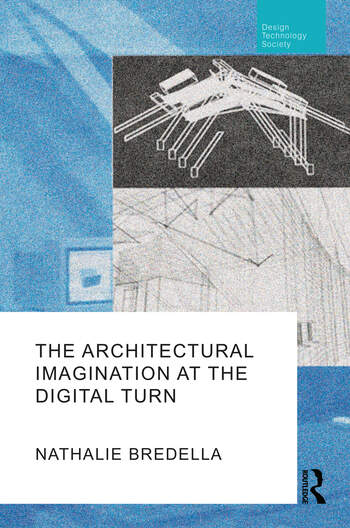
Nathalie Bredella’s The Architectural Imagination at the Digital Turn revisits digital media’s incorporation into architecture in the 1990s. While it is nearly impossible to imagine architectural production without digital tools today, architectural discourse at the time coalesced around the premise that novel tools would somehow alter fundamental disciplinary conventions. The book argues that the different ways in which architects developed, appropriated, or co-opted the digital enabled them to forge new trajectories for their practices and imagine new futures for the discipline. To demonstrate this, Bredella creates “a mosaic-like account” by selecting representative examples including academic institutions, art and media institutions, interdisciplinary collaborations on ecology, studies of the body, forays in fabrication, and investigations of the impact of the digital on the city. She examines publications, archival materials, and oral history accounts to depict a more nuanced portrait of the rise and proliferation of digital media in architecture. Bredella’s episodic approach situates these developments in a larger “material and social context”—allowing an in-depth exploration of the complexity of each case, and the limitations the architects faced or later created as individual modes of operation such as formal, algorithmic, and parametric became more popular.
The book has six chapters, which move from more theoretical and speculative ideas towards material, infrastructural, and urban explorations. Chapter 1 focuses on Columbia University’s Paperless Studios, conceived in the 1990s under Bernard Tschumi’s tenure as dean of the Graduate School of Architecture, Planning and Preservation, to talk about universities as experimental spaces where nascent theories and investigations on digital media flourished, exploring the formal and infrastructural capacities of computational technologies. In chapter 2, Bredella argues that art and media institutes expanded the role of digital technology, freeing architects to think beyond disciplinary restrictions through installations and symposia. In chapter 3, she shows how ecology shaped the relationship between architecture, technology, and culture, discussing the work of the Dutch architectural firm NOX, founded by Lars Spuybroek and Marcus Nio, who created “mediated design environments” where human and machine intersected through digital and physical space. Chapter 4 examines the production of an architectural body through computer-based design, focusing on Greg Lynn. Chapter 5, on digital networks and fabrication methods, sheds light on Objectile (Bernard Cache and Patrick Beaucé) by simultaneously examining Keller Easterling’s work on networks and globalization. Chapter 6 turns its attention to the city, exploring the work of Frank Gehry (the Guggenheim Museum in Bilbao and the Walt Disney Concert Hall in Los Angeles in particular) for its critical role in urban development, as well as technological innovations in representation and construction. The epilogue suggests that instead of a sharp turn, architects explored different facets of these newly found digital technologies in new structures and modes of operation, in ways that were both novel and yet continuous with past practices.
Bredella breaks down the steps and digital processes that led to well-known architectural projects, making unexpected connections across scales in some cases. For example, she pairs Easterling’s speculative projects scrutinizing global networks with Cache and Beaucé’s Objectile to focus on the “infrastructure behind architecture,” which involves the development of software (design) and hardware (fabrication). Bredella suggests that as different as these two systems may be—with Easterling’s relational connections across economy and politics and Cache’s preoccupation with a more formal and therefore abstract realm—they both extended the realm of digital to that of “territories and landscapes.” In another case, she bridges feminist writings on the body by Donna Haraway, Jennifer Bloomer, and Catherine Ingraham with Lynn’s theories of the Embryological House to assert that he “quietly echoed” feminist and poststructuralist theories. While some of the pairings are more coherent than others, Bredella’s efforts in mapping a universe of intellectual and artistic influences around each case study—whether they unfold in parallel, are complementary, or act oppositionally—are central to the book’s argument. In insisting on architecture being situated in a more expansive network of connections and affirming that architects activated such divergent influences within their modes of working, Bredella suggests that imagining future trajectories for the discipline are always shaped by both internal desires as well as external vectors and forces. Drawing from media theory, urbanism, ecology, globalization discourse, Marxism, cybernetics, and other fields, Bredella performs a methodology aligned with her claim that “contingency and multiple destinies” shape digital engagement. In doing so, she gives a more nuanced view of architecture’s relationship to its media, which are also shaped by social, intellectual, and political dynamics.
Due to the heterogeneity of digital media, a large cast of characters, and the multitude of transdisciplinary approaches Bredella covers, the connections between individual chapters and their specific roles in the larger book are less coherent. Bredella’s brief discussions of the success and limitations of her protagonists’ work often appear at the end of the chapters and leave the reader wanting more. Her concise observations make the reader wonder how her protagonists’ distinct works may have overlapped, were at odds, or simply existed in parallel worlds. For example, the first chapter discusses Greg Lynn, Hani Rashid, Scott Marble, Stan Allen, Keller Easterling, and Bernard Tschumi as part of the paperless studios, but only the work of Easterling, Lynn, and Rashid is engaged at later instances. At the same time, not all her protagonists’ work is comparable in terms of theory, scope, or scale, as in the cases of Bernard Cache and Frank Gehry. Nevertheless, Bredella straddles a fine line between a neutral tone and measured criticism throughout. The best morsels are where she speaks in support of a protagonist, as she does with Tschumi, or when she pushes back on others, as with Gehry, giving the reader a more direct and critical stance on the tableau-like depictions of digital culture. Bredella’s work is ultimately noteworthy for examining the digital as a set of tangled and infinitely interconnected weavings, which despite adhering to the conceit of the digital as a web, positions it as a dynamic and eclectically constructed cultural sphere.
Pari Riahi is a Registered Architect, Associate Professor of Architecture, and Associate Dean of Research and Engagement in the College of Humanities at the University of Massachusetts Amherst. Prior to joining UMass, she taught at RISD, MIT, and SUNY Buffalo. Riahi completed her PhD at McGill University in 2010. Her first book, Ars et Ingenium: The Embodiment of Imagination in Francesco di Giorgio Martini’s Drawings (Routledge, 2015) traces the historical inclusion of drawing as a component of architectural design.
She is the instigator, co-convenor and co-editor of a series on contemporary architecture: Exactitude: On Precision and Play in Contemporary Architecture (UMass Press, 2022), Multiplicity: On Constraint and Agency in Contemporary Architecture (UMass Press, 2024) and Quickness: On the rhythms of Time in Contemporary Architecture (UMass Press, Projected 2026).
Riahi’s work has been published in the Journal of Architecture, Journal of Architectural Education and Journal of Interior Architecture and Adaptive Reuse. She is currently working on a book project titled: Architectures of Collectivity: Open and Public Grounds of Parisian Suburbs.